
Why Strength Training Is the Best Falls Prevention Strategy

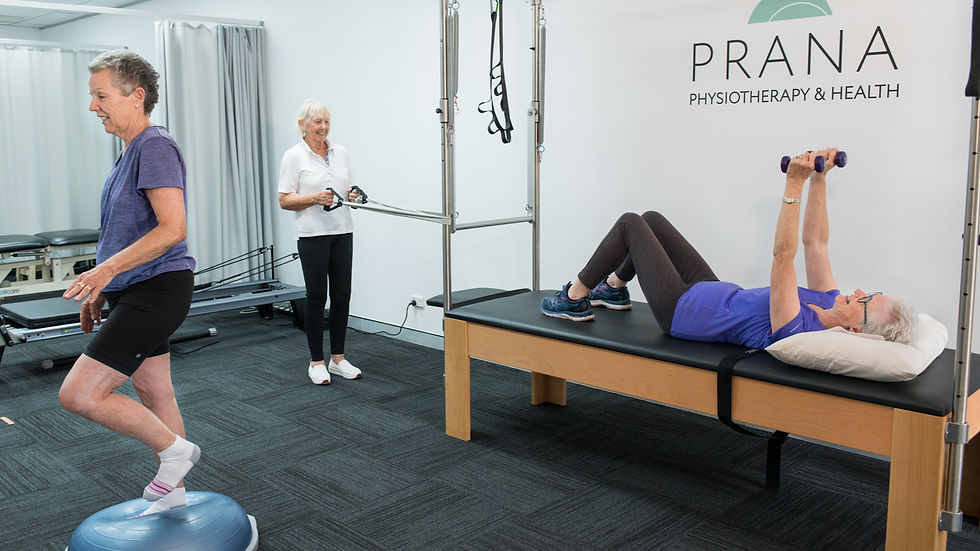
Most people picture a fall as a stroke of bad luck. A loose mat. An uneven step. A moment of inattention.
The truth is more useful than that.
Falls happen because of a stack of factors that build up quietly over time and at the top of that stack, almost always, is strength. More specifically, the loss of muscle mass and lower-limb power that creeps in from our forties onwards and accelerates after sixty. By the time someone has had their first "near miss," it's rarely a balance problem in isolation. It's that the legs no longer have the horsepower to recover the body when balance slips.
Balance, reaction time and coordination matter. But without strength underneath them, they have nothing to work with.
The good news? Strength is the most modifiable factor in the whole equation.
Why "just walking more" isn't enough
Walking is wonderful. It is not, however, strength training.
To meaningfully reduce your risk of falls, research shows exercise needs to do three things: challenge your muscles enough to get stronger, gradually increase over time, and be done consistently long enough for your body to adapt. Walking, gardening and gentle classes are great for maintaining what you already have, but they rarely rebuild lost strength.
What builds it is resistance training that feels challenging, gradually increases over time, and is done consistently for months and years, not just a few weeks.
This is where physiotherapy really matters. Not just by giving you exercises, but by setting the right level for your body and adjusting for any existing injuries or health conditions.

How we approach strength-based falls prevention at Prana
When you come to Prana for a falls and strength assessment, here’s what we’re actually doing behind the scenes:
We measure strength objectively, not by feel. Our AXIT strength testing system gives us hard numbers on lower-limb force, side-to-side asymmetries, and where you sit relative to age-matched norms. People are routinely surprised and gain great value in seeing the data and having an objective assessment.
We load you appropriately. Exercises need to be challenging but exercise prescription needs to be smart. Our physiotherapy team communicates with your medical specialists where needed to ensure that you are exercising safety. We currently work with those with osteoarthritis, cardiovascular conditions or neurological issues.
We progress the program as you respond. Repetitions, weights, range of motion, complexity of movements, speed of contraction get adjusted as you adapt.
We treat pain as information. We know that flare ups occur over time. The value of our programs is that because they are led by a Physiotherapist, modifications can be made to keep you active and exercising safely.
We build the habit, through support and community. Behaviour change is a clinical skill. Goal-setting, regular check-ins, and follow-through over time are key. Our Strength Bones & Balance community keep each other motivated, working together on the same goal.

"I'm not old enough to be thinking about this"
Here's something worth saying clearly: falls prevention is something to think about in each decade of life.
Adults lose roughly 3–8% of muscle mass per decade from their thirties, and the rate accelerates after sixty. Power, which is the ability to produce force quickly, which is what catches you when you trip declines even faster than strength. The legs that protect you in your seventies and eighties are built, or lost, across the decades before.
This is where physiotherapy-led strength work, Clinical Pilates and objective testing intersect. We're not trying to turn anyone into a powerlifter (unless you want to be!). We're trying to make sure the muscles, bones and nervous system that you'll need in our senior years, are still there when you arrive.
When to book an assessment
If you, a parent, partner or friend has noticed any of the following recently, it's worth a conversation:
More than one trip, slip or near-miss in the past year
Getting up from a low chair or the floor feels harder than it used to
Stairs feel different, particularly going down
Avoiding hills, uneven ground, or busy footpaths
A new medication, surgery, or change in vision
A growing worry about falling that's starting to shape your choices
Falls prevention isn't optional. It's fundamental. And the strongest version of you in ten years' time is being built or not by what you do this year.
Ready to take the next step? Book a Strength Bones & Balance assessment with our team at Prana Physiotherapy & Health. Call our reception or book an appointment online.


